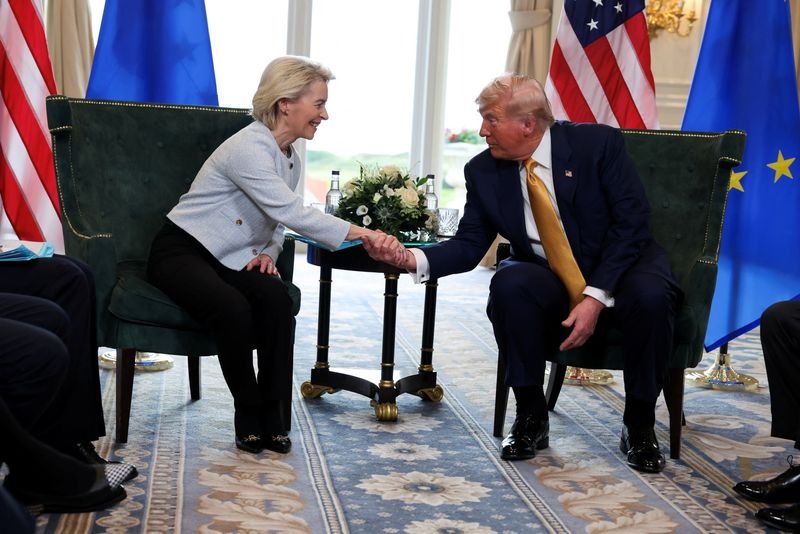
Trade war fears may no longer be dominating the spotlight, but beneath the surface, the global trade regime remains a moving target, with new deals, shifting deadlines, and policy lags fueling persistent uncertainty for businesses and investors alike. But as markets celebrate recent U.S. deals with the EU and Japan, the tariff story is far from over—a reality set to linger well into year-end and beyond, Morgan Stanley analysts warned in a recent note.
"Tariffs are likely to remain a moving target. Deals that have been announced lack clarity or legal foundations, making it hard to assess their longevity," Morgan Stanley analysts said, warning that announced agreements often “lack a legal structure, legislative process, and sector details... raising key questions, especially for businesses trying to invest”
Baseline Trajectory: Higher but Volatile Tariffs into Year-End Morgan Stanley’s expects a “steady state...global baseline of ~10-15% tariffs,” with higher rates reserved for China (potentially 20-45%). The analysts stress the volatility and execution risks remain as recent headline agreements remain “difficult to implement and track.” “Trade policy uncertainty in the aggregate is still high, with the potential for future frictions as these agreements are difficult to implement and track,” they added.
Current Tariff Landscape: Hard to Pin Down Despite a flurry of deals, “the post-August tariff landscape remains broadly consistent with our base case. Though, we caution that tariff levels remain difficult to pin down with precision because of volatility in import shares, compliance rates under USMCA, and the inherent lag in shipping data,” The EU deal, in particular, “seems to have raised tariff levels from ~10% to ~15%, contributing as much as 2 percentage points to the overall tariff rate on US imports,” especially as pharma and semis lose exemptions.
3rd party Ad. Not an offer or recommendation by Investing.com. See disclosure here or remove ads. Tariffs Showing Up in Data—With a Lag The actual impact of tariffs is only just beginning to filter into the numbers. May’s U.S. import data reflected an effective tariff rate of just 8.3%, but analysts expect “convergence in June and July to a mid-teens effective tariff rate” as shipping delays and in-transit exemptions expire. “We did see very clear signs of tariff-driven inflation across most goods” in the June CPI print, and Morgan Stanley expects “tariffs to result in up to 1 percentage point level shift in prices in the coming months before subsiding as demand softens in reaction”
Supply Chains Scramble in Real Time Companies aren’t waiting for the dust to settle. Morgan Stanley said, pointing to material shift in supply chains to Vietnam and India. “Material shifts to Vietnam and India are visible in recent months” across electronics supply chains, as firms react to changing tariff regimes. China’s share of U.S. imports slumped to just 7.7% in May from 13.7% in 2024, but could rebound as embargo-level tariffs are relaxed. Tariffs on Mexico and Canada, meanwhile, have been lower than expected at 4.3% and 1.9%, respectively; this is likely due to a "combination of unexpectedly high USMCA compliance, significant US content in autos, and possibly lenient enforcement.” Inventory Frontloading: Not as Widespread as Feared Front-loading effects, meanwhile, were more targeted than broad-based. “Roughly 80% of the increase in Q1 imports was driven by just seven HS6 categories including gold, pharmaceuticals, and AI-related goods... Excluding these, the cumulative excess imports compared to 2024 levels amounted to less than 2% of annual imports,” the analysts found. By May, as tariffs took hold, overall import volumes fell 5%.
Sector-Specific Winners—and Losers Sectors are experiencing varying levels of impact from tariffs. “Tariffs were highest in sectors like Fabricated Metal Products (Section 232 tariffs) and Textiles and Apparel...where May rates remained elevated at ~24% and ~20%, respectively. These sectors, however, account for a relatively small share of total imports. In contrast, high-volume categories such as Computers & Electronics, Chemicals & Pharmaceuticals, and fuels faced much lower tariff rates—under 10%—"dampening the aggregate inflationary impulse," the analysts added. The costs are falling squarely on U.S. importers, not exporters, and “volumes are giving way rather than prices...[but] we are early in the tariff story, and things are very much in flux”