
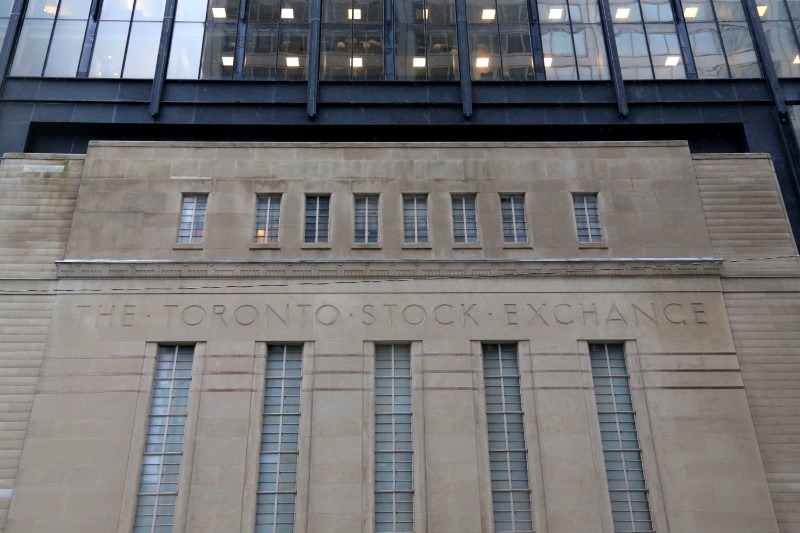
Canada’s main stock exchange was lower on Wednesday after The Bank of Canada cut its benchmark interest rate by 25 basis points to 2.25% and the U.S. Federal Reserve cut interest rates, though cooled expectations about the certainty of further rate cuts ahead.
By 4.01 ET, the S&P/TSX 60 index standard futures contract was down 19 points, or 1.09%.
The S&P/TSX composite index was down 274 points or 0.90% at 30,144.78.
Index closed higher by 0.48% at 30,419.68 on Tuesday, lifted by an increase in domestic technology industry players like Celestica and Dye & Durham. The materials sector, a major component of the commodity-heavy index, also ticked up by 0.8%, helping offset a 1.1% drop in energy shares.
Canada brought rates down for the second consecutive meeting amid mounting economic headwinds. Governor Tiff Macklem said the move reflects “ongoing weakness in the economy and contained inflationary pressures,” as Canada grapples with the fallout from escalating US protectionism.
In its October Monetary Policy Report, the central bank projected that Canada’s GDP would grow just 1.2% in 2025, followed by a modest 1.1% in 2026 and a slight pickup to 1.6% in 2027. The Bank warned that the domestic economy is undergoing more than a cyclical slowdown, describing the situation as “a structural transition” driven largely by persistent trade conflicts with the United States.
Like its counterpart in the United States also cut interest rates, though cooled expectations about the certainty of further rate cuts ahead.
3rd party Ad. Not an offer or recommendation by Investing.com. See disclosure here or remove ads. U.S. stocks gain
At 4:00 p.m. ET (20:00 GMT), the Dow Jones Industrial Average fell 73 points, or 0.2%, the S&P 500 index closed marginally lower, and the NASDAQ Composite gained 0.6%.
Fed cuts rates, sets up end of QT The Federal Reserve cut interest rates by 25 basis points on Wednesday for the second time this year, citing concerns about a softening labor market. The central bank also said it would stop reducing the size of its balance sheet as soon as December, marking the end of its quantitative tightening program.
The rate cut decision was largely expected, though there were two Fed members who dissented against decision to cut by 0.25%
Global sentiment has been boosted by news that U.S. President Donald Trump and Chinese President Xi Jinping are set to meet later this week, with negotiators finalizing a framework to avert new tariffs and sanctions.
Nvidia jumps; earnings-heavy week in focus
In the corporate sector, earnings are due from software giant Microsoft, Instagram-owner Meta Platforms and Google-parent Alphabet after the close on Wall Street.
These results are set to be followed on Thursday by iPhone-maker Apple and e-commerce titan Amazon.
Such is their massive size and sway over investors that these reports stand to heavily dictate the trajectory of U.S. equities heading into the final months of 2025.
Elsewhere, Nvidia will also be in the spotlight after Trump said he plans to discuss the company’s Blackwell artificial intelligence processors with Xi, fueling speculation that Washington could ease restrictions on chip exports to China.
3rd party Ad. Not an offer or recommendation by Investing.com. See disclosure here or remove ads. Trump had previously signaled that he might consider allowing Nvidia to export a downgraded version of its latest AI processor to China — a move that would mark a major policy shift and potential breakthrough in U.S.-China tech relations.
Nvidia shares rose in premarket trading. Should these gains hold, the chipmaker would become the first $5 trillion company.
Crude stable after API data
Oil prices stabilized after recent losses following an unexpected draw in U.S. oil inventories, with trading ranges tight ahead of the conclusion of a Federal Reserve meeting.
Brent futures gained 0.1% to $63.89 a barrel, and U.S. West Texas Intermediate crude futures traded 0.1% higher to $60.20 a barrel.
The crude market had suffered two straight days of losses following a report that the Organization of Petroleum Exporting Countries and allies, a group known as OPEC+, is considering increasing oil production in December.
Data from industry body American Petroleum Institute, released on Tuesday, showed U.S. crude inventories fell by just over 4 million barrels for the week ended October 24, while gasoline inventories dropped by 6.35 million barrels.
The larger-than-expected draws triggered a short-term price surge during the last trading session and supported the market early this morning.
Gold rebounds
Gold prices bounced back above the $4,000-per-ounce level after hovering near three-week lows, as market participants weighed signs of easing trade tensions against the expected Fed rate cut later in the day.