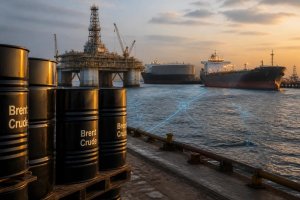
Oil prices on Monday were largely higher in a topsy-turvy session, as escalating fighting in the Middle East appeared to contradict U.S. assertions that peace talks with Iran were ongoing.
Yemen’s Houthi group entered the fray over the weekend, attacking Israel and threatening to further broaden the war as the conflict enters its second month. President Donald Trump threatened to attack Iranian energy infrastructure and the critical Kharg island if the country did not reach a deal with the U.S.
At 15:52 ET (19:52 GMT), Brent oil futures expiring in June were up 2.8% to $108.24 a barrel, while the contract expiring in May added 1.1% to $113.83 a barrel. West Texas Intermediate crude futures rose 4.6% to $104.22 a barrel.
Get oil insights with InvestingPro - now 50% off
Trump threatens key targets even as U.S. says talks ongoing Trump on Monday morning said the U.S. was in "serious discussions with A NEW, AND MORE REASONABLE, REGIME to end our Military Operations in Iran."
"Great progress has been made but, if for any reason a deal is not shortly reached, which it probably will be, and if the Hormuz Strait is not immediately ’Open for Business,’ we will conclude our lovely ’stay’ in Iran by blowing up and completely obliterating all of their Electric Generating Plants, Oil Wells and Kharg Island (and possibly all desalinization plants!), which we have purposefully not yet ’touched,’" the president added.
Iran has continued to deny any talks. Iran’s state media on Monday said Iran had received messages through intermediaries about the U.S. seeking discussions, but had dismissed Washington’s demands as "excessive" and "illogical," citing foreign ministry spokesperson Esmaeil Baqaei.
The White House later told reporters that what was being publicly said was "much different than what’s being communicated to us privately."
Trump over the weekend claimed that Iran had allowed 20 oil tankers to pass through the Strait of Hormuz as concessions to the U.S. Reports showed 20 Pakistan-flagged oil tankers being allowed to cross the strait.
Meanwhile, U.S. troops are said to be pouring into the Middle East, raising fears of a ground invasion in Iran. Trump told the Financial Times that he was open to taking over Iranian oil, while a Wall Street Journal report said the U.S. was considering seizing Iran’s uranium. Both moves could involve troops on the ground and would mark a major escalation in the conflict.
“Market nervousness around the situation in the Middle East continues to ratchet up as the Iran conflict enters a fifth week,” Danni Hewson, head of financial analysis at AJ Bell, said
“Comments from President Trump about seizing Iranian oil and the country’s Kharg Island export hub, a build-up of U.S. troops and the involvement of Tehran-backed Houthis in the war all create the impression of a conflict that is escalating rather than drawing to a close," Hewson said.
“With shipping routes beyond the Strait of Hormuz now seen at some risk of disruption too, Brent crude oil prices remain firmly in alarm bell territory at more than $115 per barrel and are on course for a record monthly gain," Hewson added.
Oil was indeed sitting on steep gains in March, with Brent up nearly 60% as the onset of the U.S.-Israel war on Iran greatly disrupted global supplies. Iran effectively blocked the Strait of Hormuz, a key shipping lane through which roughly 20% of the world’s oil passes.
Houthi attacks could open new front The Yemen-based, Iran-aligned Houthis said on Sunday that they had launched a barrage of missiles against Israel, and vowed to launch more attacks.
Their joining the war sparked concerns over a potential escalation in the conflict, given that the group has the capability to attack ships passing through the Red Sea.
"The Houthis’ weekend involvement and the arrival of additional U.S. troops underscore the conflict’s widening scope," analysts at OCBC said in a note.
"With little prospect of an imminent reopening of the Strait of Hormuz, our baseline remains for Brent to stay around USD100/bbl through mid‐year before gradually easing in [the second half of 2026]."