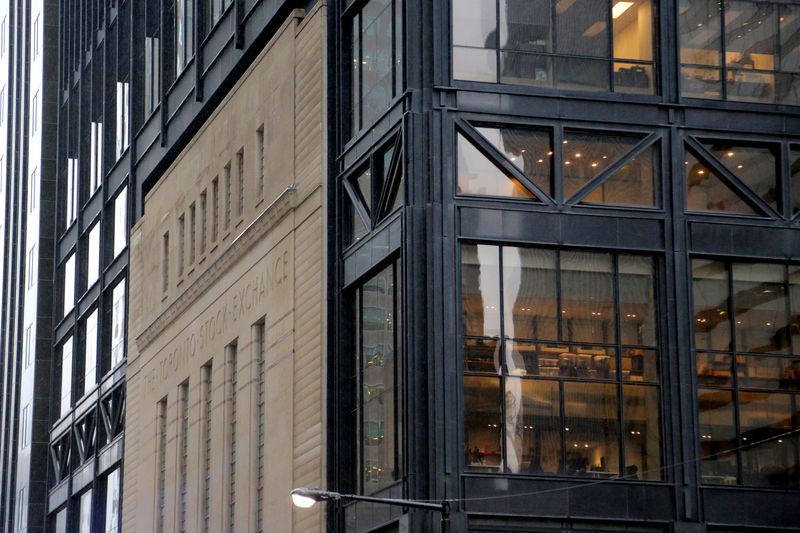
Canada’s main stock exchange index is choppy on Friday, as investors tracked a standoff between the U.S. and Iran, which has kept oil prices supported above $100 a barrel.
Track Canadian stocks with InvestingPro - now 50% off By 12:12 ET (17:12 GMT), the S&P/TSX 60 index and the Toronto Stock Exchange’s S&P/TSX composite index were mostly flat, rising just 0.03% and 0.02% respectively.
On Thursday, the Toronto Stock Exchange’s S&P/TSX composite index inched down by 0.1% to close at 33,912.93.
Canadian producer prices increased 2.4% in March from February, powered by a spike in the costs of energy, petroleum products and chemicals due to the Iran war. The prospect of rising inflation could lead central banks to consider interest rate hikes, potentially weighing on stocks.
Retail sales data due out on Friday may offer more insight into the Bank of Canada could approach its upcoming rate decision next week.
U.S. stocks mostly higher
U.S. stocks are mostly higher, buoyed in part by resilient earnings despite uncertainty around the Iran conflict. The Dow is the outlier, down 67 points, or 0.1%. The S&P 500 has risen by 52 points, or 0.7%, while the Nasdaq has ticked up by 353 points, or 1.4%.
The main averages on Wall Street closed lower on Thursday, with sentiment dampened by waning expectations that Washington and Tehran will soon notch an agreement to permanently halt hostilities and reopen the Strait of Hormuz, a vital waterway off of Iran’s southern coast which has been all but shuttered for tanker traffic for weeks.
Still, traders remained upbeat around what has so far been a solid quarterly earnings season for Corporate America. One of the standout performers in the prior session was chipmaker Texas Instruments, whose shares soared by more than 19% after the company reported results and guidance that investors cheered. The returns pulled up other semiconductor stocks as well.
A surge in demand for TI’s analog chips from data centers particularly underlined the ongoing pace of an aggressive spike in tech sector spending on artificial intelligence. Optimism around such heavy AI infrastructure expenditures has helped markets to look beyond economic headwinds from the Middle East and mostly erase losses sparked by the Iran war.
Further bolstering the tech sector was Intel, whose shares surged in premarket trading after the chipmaker projected a spike in revenue propelled by AI data center demand.
Although Intel has been viewed as one of the companies sitting on the sidelines of the AI boom, its CPU computer brain has become more popular in recent months as more firms are hunting for the computing power needed for cutting-edge autonomous AI "agents." The company has also benefited from a 10% stake from the Trump administration, as well as a move to join Tesla and SpaceX as a strategic partner in a project that includes a chip-fabrication site in Texas.
Meanwhile, Germany’s SAP notched a jump in quarterly profit that outpaced expectations. Analysts at Vital Knowledge said the figures helped to ease some worries around the software industry that arose in the wake of downbeat returns from ServiceNow this week.
"Earnings Thurs[day] night were mostly bullish, continuing a trend that’s been present since the start of the season," the Vital Knowledge analysts said.
Oil volatile amid ongoing U.S.-Iran standoff
President Donald Trump said on Thursday that a ceasefire between Israel and Lebanon would be extended for three weeks following a meeting with diplomats from both countries.
However, representatives from Hezbollah, the militant group fighting in Lebanon, were not at the talks, casting some doubt over the longevity of the truce. Firing between Israel and Hezbollah was also reported in the hours before Trump’s announcement.
Earlier this week, Trump also unveiled an indefinite ceasefire between the U.S. and Iran, but maintained an American blockade of Iranian ports.
Uncertainty has surrounded the fragile halt to hostilities. Tehran has responded to the U.S. blockade by moving to demonstrate its grip on the Strait of Hormuz by attacking and seizing ships in the vital waterway for roughly a fifth of the world’s oil. The U.S. has also seized Iranian-flagged vessels and Trump has said he has ordered the Navy to "shoot and kill" Iranian boats attempting to lay mines in the strait.
With few indications that the strait will be unblocked soon, oil prices have risen back above $100 a barrel, threatening to exacerbate fears over a spike in inflation and a slowdown in global growth. On Friday, Brent crude, the global benchmark, erased earlier gains to last sit at $104.66 a barrel.