
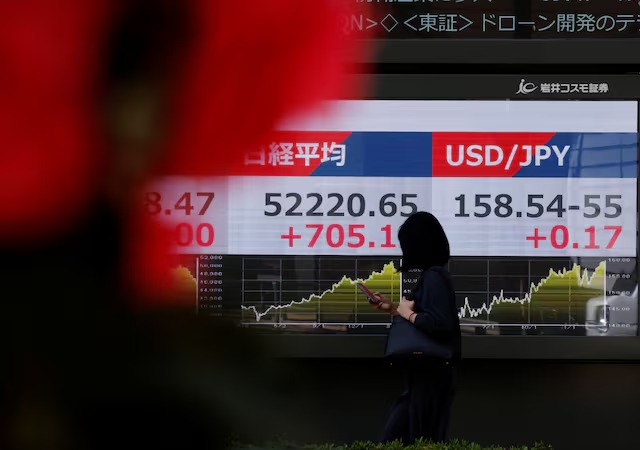
Asian stocks have seen heavy foreign outflows so far in March as disruptions to Middle East energy supply from the U.S.-Israeli war with Iran stoked fears of an oil shock and stagflation risks. Foreign investors have sold a net $50.45 billion worth of regional equities so far this month, on track for the largest monthly outflows since at least 2008, LSEG data covering exchanges in South Korea, Taiwan, Thailand, India, Indonesia, Vietnam and the Philippines showed. The Reuters Power Up newsletter provides everything you need to know about the global energy industry. Sign up here. Advertisement · Scroll to continue
Monthly foreign investment flows into Asian equities in $ million Monthly foreign investment flows into Asian equities in $ million "Outflows from EM Asia markets were driven by the broad-based risk-off sentiment due to the Middle East conflicts, as most of EM Asia economies are net importers of energy products," said Jason Lui, the head of APAC equity and derivative strategy at BNP Paribas. Benchmark Brent crude oil prices surged as much as 65% this month to $119.5 a barrel. Abdelaziz Albogdady, a market research and fintech strategy manager at brokerage FXEM, said that the outflows were exacerbated by the ensuing rise in global yields and a reassessment of rate expectations, in addition to the potential economic impact on net oil importers. Advertisement · Scroll to continue
Recent policy signals from major central banks indicate that interest rates are likely to remain on hold or move higher if the conflict continues to heap pressure on prices. Taiwanese stocks have seen about $25.28 billion in outflows month-to-date, the largest in at least 18 years, while South Korea and India have recorded about $13.5 billion and $10.17 billion in net foreign sales, respectively. "Outflows in Taiwan and South Korea were mostly focused on AI/technology stocks given they have accumulated sizable gains during the AI boom," BNP Paribas' Lui said. Tech hardware stocks in Korea and China, however, remain among the most promising segments, seeing limited immediate direct impact from the Middle East conflict or higher energy prices, analysts at Nomura said in a note on Monday.