
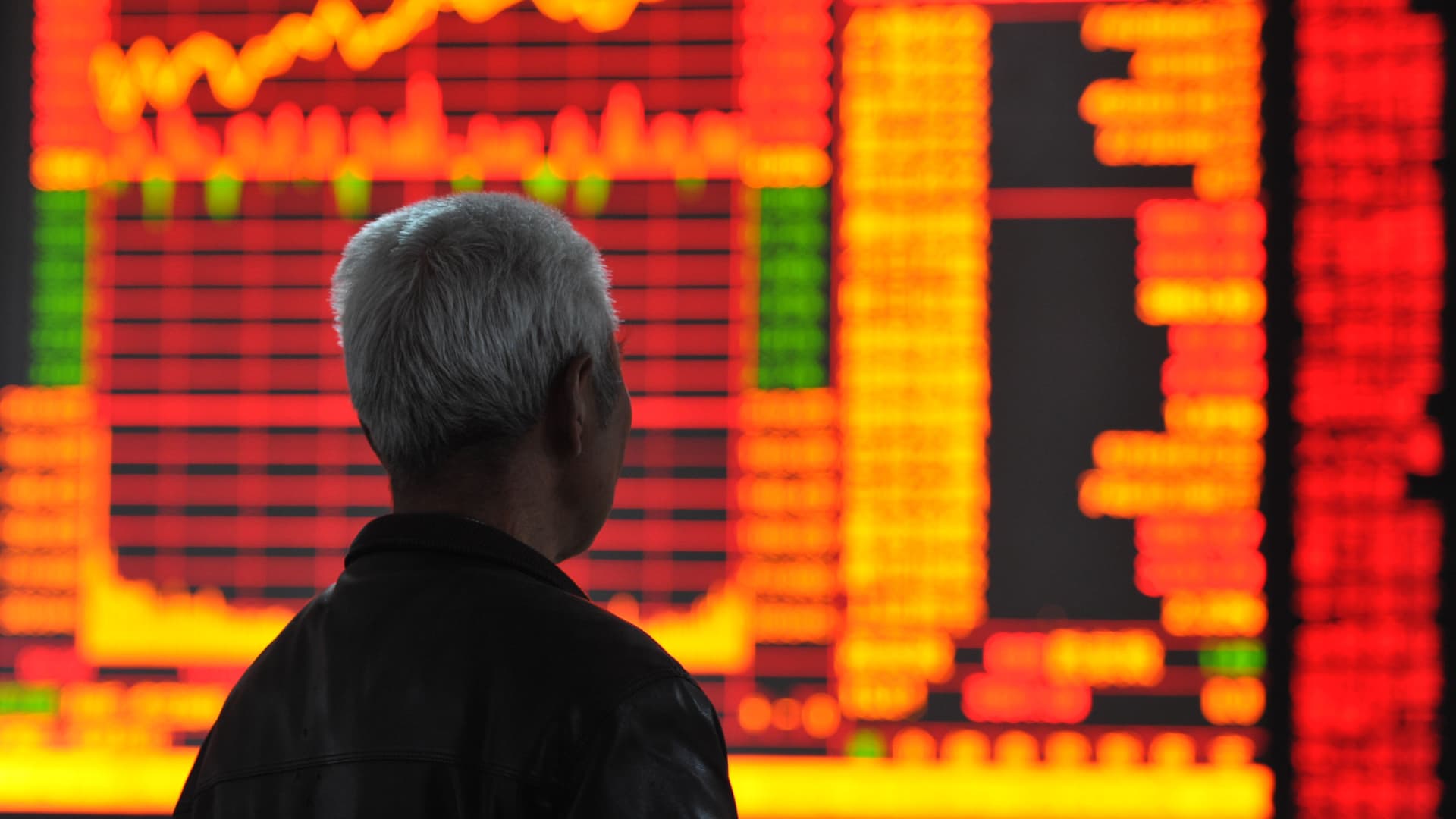
Stocks in Asia rebounded on Wednesday, shaking off earlier Wall Street-led losses as renewed enthusiasm for artificial intelligence and semiconductors breathed fresh life into China's tech-led rally.
MSCI's broadest index of Asia-Pacific shares outside Japan (.MIAPJ0000PUS), opens new tab reversing an earlier decline of as much as 0.5% earlier in the session to be up 0.1% by mid-afternoon trading.
The Reuters Tariff Watch newsletter is your daily guide to the latest global trade and tariff news. Sign up here.
Chinese stocks led the charge, with a gauge of Hong Kong-listed companies (.HSCE), opens new tab up 1.5% and the STAR 50 Index (.STAR50), opens new tab rising 3.6%. Alibaba's Hong Kong-listed shares (9988.HK), opens new tab surged as much as 7.8% after the e-commerce giant announced on Wednesday its largest ever AI model, the Qwen3-Max.
"The upward trend for A-shares has steepened since August with major indices breaking through the October 2024 highs," UBS analysts wrote in a research note. "This has created a money-making effect that is gradually attracting investors off the sidelines."
The greenback stabilised after two consecutive days of decline, with the dollar index (.DXY), opens new tab up 0.2% at 97.438. Against the yen , the dollar was up 0.3% at 148.05.
U.S. stock futures were last up 0.2%, recovering from a dip on Wall Street on Tuesday. The S&P 500 (.SPX), opens new tab sank 0.6% to mark its biggest one-day loss in three weeks, after remarks by Federal Reserve Chair Jerome Powell on Tuesday.
"U.S. equities and bond yields declined because Fed Chair Jerome Powell’s speech explicitly described equities as 'fairly highly valued' and acknowledged that there was no 'risk-free path' for policy," DBS analysts wrote in a note. "He did not commit to aggressive rate cuts due to the challenging situation of balancing the upside risk to inflation with the downside risk to employment."
Asian stocks are trading near a four-year high and remain on track this month for their best monthly performance in a year, following weakness in the dollar, a surge in regional technology stocks and a resumption of the Federal Reserve's policy easing cycle.
Australian shares (.AXJO), opens new tab were a notable drag on the Asian benchmark on Wednesday, down 0.9%, extending losses after a bigger-than-expected rise in consumer prices in August.
"Although the RBA won’t pay much heed to the pickup in headline inflation, the strength in core inflation will give it pause for thought," Capital Economics analysts wrote in a research note.
Japan's Nikkei stock index (.N225), opens new tab was last trading up 0.3%, reversing earlier declines.
Traders have ramped up bets on further U.S. rate cuts, with Fed funds futures implying a 91.9% chance of a rate cut at the central bank's October meeting, up from a 89.8% probability on Tuesday, according to the CME Group's FedWatch tool.
Longer-dated U.S. government bonds attracted buyers, with the yield on benchmark 10-year Treasury notes falling to 4.1042%, compared with its U.S. close of 4.118% on Tuesday. The two-year yield , which rises with traders' expectations of higher Fed funds rates, fell to 3.5673% compared with a U.S. close of 3.57%.