
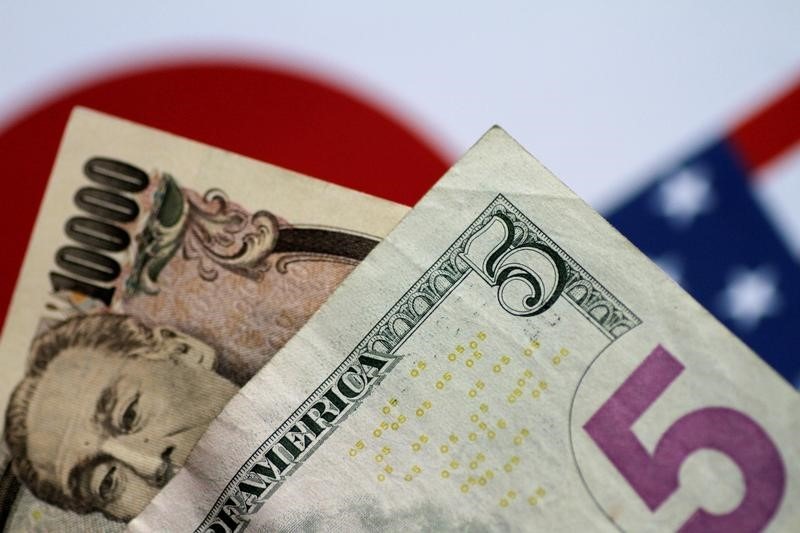
Most Asian currencies moved in a flat-to-low range on Thursday, while the dollar firmed amid growing concerns over the U.S. imposing more curbs on China, which could spark a renewed trade war between the economic giants.
The Japanese yen was among the biggest decliners for the day, reaching its weakest level in more than a week as markets bet on more fiscal and monetary easing under new Prime Minister Sanae Takaichi.
A fresh round of strict U.S. sanctions against Russia-- this time against the country’s biggest oil companies-- added to the risk-off mood.
Asia FX weakens, yuan steady as US-China trade jitters resurface Asian currencies mostly trended lower, while the Chinese yuan steadied as markets continued to fret over Sino-U.S. trade relations.
The yuan’s USD/CNY pair hovered around 7.1241 yuan, following a series of strong midpoint fixes by the People’s Bank.
Concerns over U.S.-China trade ructions resurfaced this week after reports on Wednesday showed Washington considering curbs on a slew of software-powered exports to China, in retaliation for the country’s recent rare earth export restrictions.
The reports largely overshadowed earlier comments from U.S. officials that talks with China were still ongoing, and that they hoped to avoid a broader trade conflict.
Concerns over a renewed trade war sapped risk appetite across Asian markets and weighed on regional currencies. The Australian dollar’s AUD/USD pair, which is viewed as an indicator of Asia-Pacific risk appetite, fell 0.1%, while the Singapore dollar’s USD/SGD pair rose 0.2%.
The Taiwan dollar’s USD/TWD pair rose 0.1%, while the Indian rupee’s USD/INR pair rose slightly as onshore trade resumed after market holidays this week.
Reports on Wednesday said India was close to a trade deal with the U.S., which could bring tariffs against New Delhi substantially lower from their current, 50% level.
The South Korean won’s USD/KRW pair rose 0.2%, with the won weakening even as the Bank of Korea kept interest rates unchanged and flagged caution over further monetary easing, due to a hot housing market and sticky inflation.
Yen leads losses on dovish fiscal outlook The Japanese yen was among the worst performers for the day, with the USD/JPY pair rising 0.3% to its highest level in nine days.
The yen had tumbled earlier this week after Liberal Democratic Party leader Sanae Takaichi was voted Prime Minister. Takaichi is widely viewed as a fiscal dove, and is expected to loosen fiscal and monetary conditions in the country, which heralds pressure on the yen.
But the Bank of Japan has signaled that it will keep raising interest rates if growth and inflation improve in line with its forecasts. Consumer inflation data for September is due on Friday, and comes just days before the BOJ’s late-October meeting.
Dollar firms amid macro uncertainty, CPI data awaited The dollar index and dollar index futures rose between 0.1% and 0.2% in Asian trade, adding to gains made earlier this week.