TradeStation Securities, Inc., a US-based brokerage specializing in equities and derivatives trading, has announced a new integration with QuantWheel, an options trading platform designed for directional and income-focused traders, enabling clients to analyze market opportunities, execute trades, and manage positions through a unified trading environment.
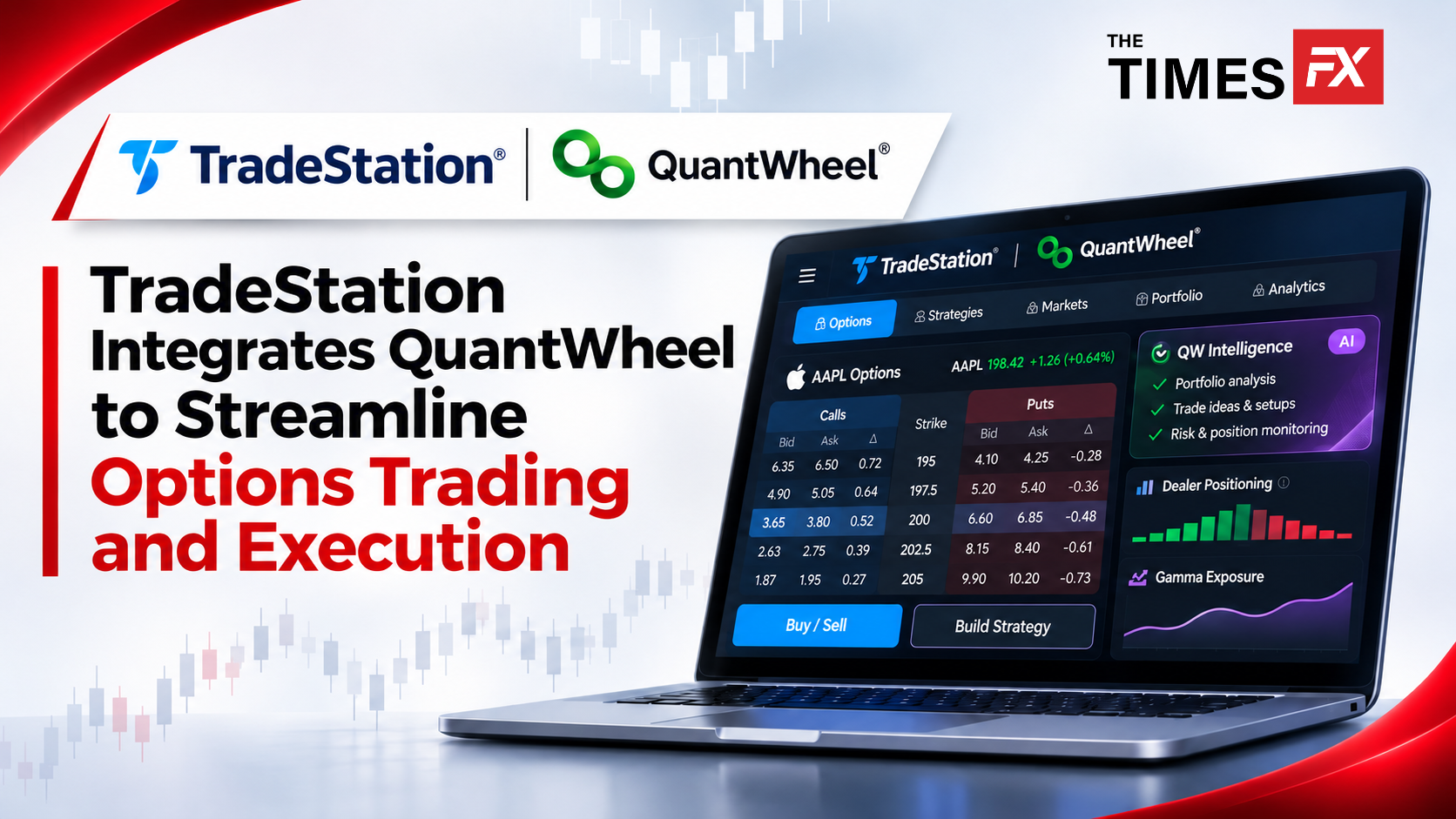
The integration connects TradeStation's brokerage execution infrastructure with QuantWheel's analytical and portfolio management capabilities, allowing traders to move between market research, strategy selection, order placement, and position monitoring without leaving the QuantWheel interface.
Under the arrangement, directional options traders can access information on dealer positioning, gamma exposure, and live options flow to evaluate market conditions and identify potential opportunities involving calls, puts, and multi-leg spreads.
Income-focused traders can use QuantWheel's screening tools to identify strategies such as cash-secured puts, covered calls, and credit spreads. The platform also provides information on positions approaching potential assignment, helping users monitor their existing options exposure.
Once traders approve an order, the transaction is transmitted to TradeStation for execution. Multi-leg strategies, including spreads and poor man's covered calls (PMCCs), can be submitted as a single order, while executed positions are synchronized with QuantWheel's integrated options journal.
This functionality is intended to reduce the need for traders to switch between separate applications for research, execution, and portfolio monitoring, while keeping final trading decisions under the user's control.
QuantWheel also incorporates an artificial intelligence assistant known as QW Intelligence, which analyzes information related to a trader's portfolio, including existing positions and cost basis, to provide responses to portfolio-related questions and conduct recurring monitoring checks.
The platform supports Model Context Protocol (MCP) and application programming interface (API) connectivity, allowing compatible external AI applications and automated workflows to interact with its analytical tools and portfolio data.
John Bartleman, President and Chief Executive Officer of TradeStation Group, emphasized that options traders frequently rely on multiple platforms to research markets, identify opportunities, execute orders, and manage positions.
According to Bartleman, the integration is designed to create a more connected trading experience by bringing these activities together while ensuring that clients retain control over the orders submitted through their brokerage accounts.
Ivan Orehovec, Co-Founder of QuantWheel, highlighted the commercial benefits available through the collaboration, including access to the platform's full Quant subscription plan at no additional subscription cost for qualifying TradeStation customers.
Eligible clients may also benefit from promotional pricing that includes zero per-contract charges on non-index options executed through QuantWheel, subject to the applicable account requirements and trading conditions.
The announced pricing structure includes a $0.75 fee per index options contract, with no contract limits or assignment fees under the specified arrangement. Other applicable regulatory and exchange charges may still apply.
Luka Knezic, Co-Founder of QuantWheel, described the collaboration as an effort to simplify the options trading process by connecting market analysis, trade identification, execution, and position management within one workflow.
The partnership forms part of TradeStation's broader strategy to develop an interconnected trading ecosystem that supports advanced trading technology and integrations with specialized third-party platforms.
TradeStation already provides access to its brokerage services through TradeStation Desktop, TradeStation Mobile, and open API connections, allowing traders to combine execution capabilities with external analytical and automation tools.
The QuantWheel integration extends these capabilities by incorporating specialized options strategy screening, portfolio monitoring, and AI-assisted analytics into the trading process.
The development also highlights the increasing role of connected platforms and artificial intelligence in derivatives trading, where traders are seeking tools that combine detailed market information with more efficient order management and portfolio analysis.
While integrated analytical services can improve access to information and simplify workflows, options trading continues to involve substantial risks, particularly when using leveraged or complex multi-leg strategies. AI-generated information may also contain inaccuracies and should not be treated as a guarantee of investment outcomes.
Through its latest integration, TradeStation is expanding the range of options trading tools available to its clients while strengthening its technology ecosystem and connectivity with third-party financial platforms.